
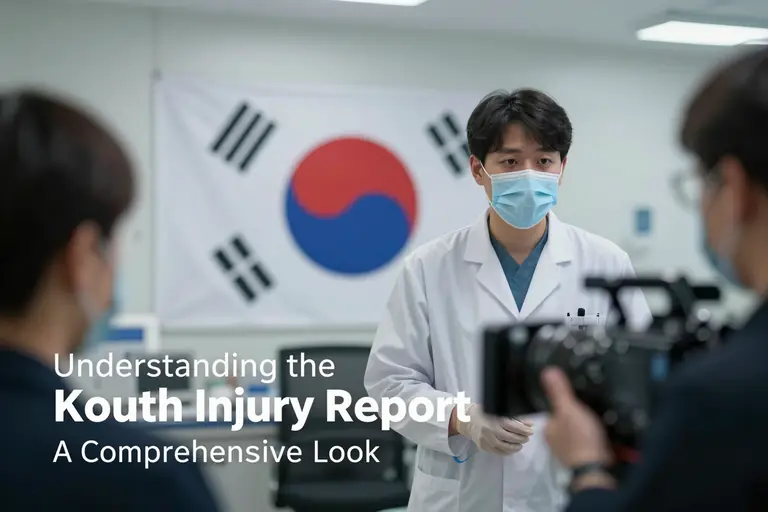
The Indispensable Role of the South Korea Injury Report in Public Health and Safety
In the realm of public health and safety, a robust and meticulously maintained injury surveillance system stands as a cornerstone for informed decision-making and strategic intervention. In South Korea, the South Korea injury report fulfills this critical function, transcending its identity as a mere compilation of statistics. It serves as a dynamic narrative of societal incidents, a crucial guide for policymakers, and an unvarnished mirror reflecting the evolving landscape of public safety challenges. A deep dive into the report’s structure, methodologies, and applications offers invaluable insights for residents, international visitors, healthcare professionals, and anyone invested in understanding the nation’s commitment to well-being.
The comprehensive scope of a typical South Korea injury report is truly remarkable. It meticulously documents a vast array of incidents, ranging from the pervasive dangers of traffic accidents and the specific hazards of workplace mishaps to the often-overlooked occurrences of sports injuries and domestic incidents. Each category within the report provides a unique and nuanced perspective on the diverse types of risks individuals encounter in their daily lives, thereby pinpointing areas where interventions are most critically needed. For instance, a persistent increase in pedestrian injuries might immediately trigger a thorough review of existing crosswalk safety protocols, traffic signal timings, and urban planning designs. Conversely, a noticeable surge in construction-related accidents would inevitably lead to more stringent enforcement of occupational safety standards, a re-evaluation of training programs, and potentially new legislative measures. This continuous and dynamic feedback loop, powered by the data within the South Korea injury report, is absolutely essential for fostering perpetual improvement in public safety outcomes and ensuring the well-being of the population.
Key Components and Data Points Within a Typical South Korea Injury Report
A truly comprehensive South Korea injury report is a mosaic of data, meticulously compiled from a diverse array of authoritative sources. These typically include, but are not limited to, detailed records from hospital emergency rooms, official police reports, logs from fire departments, and even aggregated data from insurance claims. The overarching objective is to construct the most complete and accurate picture possible of injury occurrences, their immediate and underlying causes, and their subsequent outcomes. Key data points that are consistently found and analyzed within a South Korea injury report include:
- Demographic Profile of the Injured Individuals: This includes crucial information such as age, gender, occupation, and precise residential area. Such data helps in identifying high-risk demographic clusters.
- Specific Type of Injury Sustained: Detailed categorization of injuries, including fractures, sprains, lacerations, burns, concussions, internal organ damage, and other specific trauma. This informs treatment protocols and prevention strategies.
- Mechanism and Cause of Injury: Identification of the precipitating event, such as falls, vehicular collisions, cuts from sharp objects, poisoning (accidental or intentional), sports-related incidents, acts of violence, or natural disasters.
- Precise Location of Injury Occurrence: Categorization by environment, including home, workplace, public roads, recreational facilities, schools, or other specific locations. This helps in targeted environmental modifications.
- Severity and Outcome of Injury: Assessment of the injury’s impact, ranging from requiring immediate emergency treatment and short-term hospitalization to necessitating long-term care, rehabilitation, or, tragically, resulting in fatality. This metric guides resource allocation.
- Temporal Data (Time and Date of Injury): Analysis of patterns related to specific times of day, days of the week, or even seasons. This can reveal behavioral or environmental factors at play.
The meticulous analysis of these interconnected components empowers health authorities, epidemiologists, and public health researchers to identify specific high-risk groups, hazardous environments, and dangerous activities with precision. For example, if the South Korea injury report consistently highlights a significantly higher incidence of falls among the elderly population within residential settings, this data would directly inform the development of highly targeted prevention programs. These programs could encompass initiatives focusing on home safety modifications (e.g., grab bars, improved lighting), community-based balance improvement exercises, and educational campaigns on medication side effects that might increase fall risk. This evidence-based approach is fundamental to effective injury prevention.
Analyzing Longitudinal Trends and Emerging Patterns for Proactive Intervention
One of the most potent and transformative aspects of the South Korea injury report lies in its unparalleled ability to reveal significant trends and patterns over extended periods. By systematically comparing reports from successive years or specific temporal intervals, experts can rigorously assess the efficacy of existing safety initiatives, identify unexpected emerging risks, and forecast potential future challenges. For instance, a sustained and measurable decrease in traffic fatalities over several years might be directly attributed to the success of newly implemented road safety campaigns, more stringent driving laws, or advancements in vehicle safety technology. Conversely, an unanticipated or sudden rise in specific types of injuries could serve as an immediate red flag, signaling new public health challenges that demand prompt and decisive attention.
“The wealth of data encapsulated within the South Korea injury report transcends mere statistical compilation; it functions as an indispensable roadmap for systematically constructing a safer, healthier society. Each individual data point, every recorded incident, represents a profound learning opportunity and a tangible chance to proactively prevent future harm and mitigate suffering.”
This sophisticated trend analysis is not confined solely to national averages or broad-stroke generalizations. The South Korea injury report also meticulously captures regional variations, which can illuminate highly specific local issues and unique challenges. For example, a particular province might consistently exhibit a disproportionately higher rate of agricultural injuries, directly reflecting its predominant economic activities and associated occupational hazards. In contrast, another urbanized region might grapple with a surge in incidents related to pedestrian-vehicle collisions or public transport accidents. Such granular, localized data is absolutely critical for enabling the design and implementation of highly localized interventions that are far more likely to be effective because they directly address the unique socio-economic, environmental, and behavioral circumstances of each distinct area. This nuanced, localized understanding, meticulously presented within the South Korea injury report, is indispensable for achieving truly impactful and sustainable public safety improvements.
The Collaborative Ecosystem of Data Contributors to the South Korea Injury Report
The compilation of a truly comprehensive and accurate South Korea injury report is a testament to extensive collaboration, involving a diverse array of government agencies, dedicated healthcare providers, academic research institutions, and even proactive private organizations. Each distinct sector plays an absolutely crucial role in ensuring the accuracy, completeness, and ultimately, the utility of the collected data:
- Healthcare Facilities (Hospitals, Clinics, Emergency Rooms): These institutions serve as primary data sources, meticulously documenting the immediate medical impact of injuries, ranging from initial assessment to treatment and discharge. Their detailed records form the fundamental medical backbone of the South Korea injury report.
- Law Enforcement Agencies (Police Departments): Police forces are vital contributors, providing detailed reports on traffic accidents, criminal assaults, domestic violence incidents, and other occurrences that fall under their purview of public safety. These reports often offer critical contextual information regarding the circumstances and events preceding the injury.
- Occupational Safety and Health Agencies (e.g., KOSHA – Korea Occupational Safety & Health Agency): These specialized bodies focus exclusively on workplace injuries, occupational diseases, and industrial accidents. They ensure that these incidents are exhaustively investigated, documented, and reported, significantly enriching the occupational health segment of the South Korea injury report.
- Academic and Research Institutions (Universities, Public Health Institutes): These entities frequently take on the crucial role of analyzing the raw data provided by the various agencies. They conduct in-depth epidemiological studies, identify underlying risk factors, develop predictive models, and propose evidence-based prevention strategies, thereby adding significant analytical depth to the South Korea injury report.
- Public Awareness and Advocacy Organizations: While not direct data reporting entities, organizations involved in public awareness campaigns (e.g., road safety, fire prevention) heavily rely on the insights derived from the South Korea injury report. They use this data to precisely tailor their messages, identify target audiences, and focus on high-risk behaviors or populations, thereby amplifying the report’s impact.
The synergistic interplay and coordinated efforts among these diverse contributors guarantee that the South Korea injury report is multifaceted, robust, and exceptionally reliable, offering a truly holistic and granular view of injury epidemiology across the nation.
Translating Data into Action: Preventive Measures and Policy Implications
The ultimate and overarching goal of meticulously compiling, rigorously analyzing, and widely disseminating the South Korea injury report is to definitively inform and continually improve preventive measures and public policy. Without the bedrock of reliable, evidence-based data, any efforts to enhance public safety would be largely based on conjecture, anecdotal evidence, or intuition rather than proven facts. The South Korea injury report provides the essential empirical evidence necessary to:
- Develop Highly Targeted Safety Campaigns: For instance, if the report consistently indicates a high prevalence of bicycle-related head injuries among adolescents, public health campaigns promoting mandatory helmet use, safe cycling practices, and dedicated bike lanes can be intensified and strategically deployed.
- Implement and Enforce Regulatory Changes: Patterns identified in the South Korea injury report can directly lead to the introduction of new, safer building codes, the establishment of more rigorous vehicle inspection standards, the enhancement of workplace safety regulations, or stricter product safety guidelines.
- Allocate Resources with Optimal Effectiveness: The data allows for the strategic direction of financial, human, and technological resources towards geographical areas, demographic groups, or injury types that bear the highest burden of injury, thereby ensuring that interventions yield the greatest possible impact and return on investment.
- Educate and Empower the Public: By widely disseminating clear, actionable information about common injury risks, effective prevention strategies, and emergency response protocols, the public is empowered to make more informed and safer choices in their daily lives, fostering a culture of proactive safety.
Consider the profound impact of the South Korea injury report on national road safety strategies. If the report consistently highlights a disproportionately high number of motorcycle accidents, particularly among certain age groups or in specific regions, policymakers would be compelled to consider implementing mandatory advanced rider training programs, increasing public awareness campaigns targeting motorcyclists, or even introducing stricter penalties for reckless driving behaviors. Each individual data point, each reported incident within the South Korea injury report, holds the immense potential to catalyze positive, life-saving change.
Navigating Challenges in Data Collection, Analysis, and Dissemination
While the South Korea injury report stands as an undeniably invaluable resource, its comprehensive compilation and continuous refinement are not without significant challenges. These can include, but are not limited to, issues of underreporting (where minor injuries may not be officially recorded), inconsistencies in data collection methodologies across different contributing agencies, and the inherent difficulty of accurately capturing non-fatal injuries that do not necessitate immediate medical attention. For example, a minor sprain, bruise, or small cut might not always make its way into official medical records or police reports, leading to a potentially incomplete picture of the true burden of minor injuries. Ensuring the highest possible accuracy, consistency, and completeness of the South Korea injury report is an ongoing, dynamic process that requires continuous vigilance and methodological improvement.
Another critical challenge lies in the timely and efficient dissemination of the report’s findings. For prevention efforts to be maximally effective, the collected data needs to be analyzed, interpreted, and communicated to relevant stakeholders and the public with promptness. Delays in this process can mean that crucial interventions are not implemented as quickly as they should be, potentially leading to a higher incidence of preventable injuries. Continuous efforts are therefore made to streamline the entire process of producing, analyzing, and widely distributing the South Korea injury report, leveraging modern data management and communication technologies.
The Evolving Future of the South Korea Injury Report: Leveraging Technology and Innovation
Looking towards the horizon, the South Korea injury report is poised to benefit significantly from exponential advancements in technology and the burgeoning field of data science. The strategic integration of cutting-edge artificial intelligence (AI) and sophisticated machine learning (ML) algorithms holds immense promise. These technologies could help in identifying intricate and complex patterns, subtle correlations, and predictive indicators that are not immediately obvious through traditional statistical analysis. Furthermore, achieving greater interoperability and seamless data exchange between disparate data systems and agencies could lead to an even more cohesive, comprehensive, and real-time South Korea injury report, significantly reducing reporting burdens, minimizing data silos, and dramatically improving overall data quality and responsiveness.
There is also a growing and urgent emphasis on the development of real-time or near real-time data reporting systems. Imagine a future South Korea injury report that updates almost instantaneously, providing public health authorities with immediate insights into emerging threats, allowing them to react with unprecedented speed and precision. Such a system would profoundly enhance the responsiveness, agility, and overall effectiveness of public health and safety systems nationwide. The continuous evolution and technological advancement of the South Korea injury report are absolutely critical for sustaining and accelerating progress in injury prevention and control efforts, ensuring that the nation remains at the forefront of public safety innovation.
In summation, the South Korea injury report is far more than a mere administrative document or a collection of dry statistics. It stands as a living, breathing testament to a nation’s unwavering commitment to safeguarding and protecting its citizens. It is a dynamic, indispensable tool for profoundly understanding public health challenges, and it serves as a foundational, evidence-based element for actively fostering a progressively safer and healthier environment for every individual residing within or visiting the country. From precisely identifying specific high-risk scenarios and vulnerable populations to meticulously guiding critical policy decisions and resource allocation, the profound importance and far-reaching impact of this report cannot be overstated. Every concerted effort directed towards enhancing its accuracy, improving its accessibility, and ensuring its timeliness directly contributes to the overarching well-being and prosperity of the entire South Korean population, simultaneously serving as an exemplary model for comprehensive and proactive safety surveillance globally.
Frequently Asked Questions (FAQ) about the South Korea Injury Report
What is the primary purpose and overarching goal of the South Korea injury report?
The primary purpose of the South Korea injury report is to systematically collect, rigorously analyze, and widely disseminate comprehensive data on injuries occurring across the nation. This meticulously gathered information is then strategically utilized to understand complex injury patterns, accurately identify high-risk groups and hazardous environments, and ultimately inform the development of highly effective public health policies and targeted prevention strategies. The overarching goal is to significantly reduce the incidence, severity, and societal burden of injuries, thereby enhancing overall public safety and well-being.
Which entities and organizations contribute data to the South Korea injury report?
A diverse and collaborative network of entities contributes critical data to the South Korea injury report. These include, but are not limited to, various healthcare facilities (such as hospitals, emergency rooms, and clinics), law enforcement agencies (including national and local police departments), specialized occupational safety and health organizations (like KOSHA), and prominent academic and research institutions. This multi-sectoral collaborative effort ensures a comprehensive and multi-dimensional overview of injury occurrences from various authoritative perspectives.
How does the South Korea injury report actively contribute to preventing future injuries and enhancing public safety?
By meticulously analyzing the rich and granular data contained within the South Korea injury report, authorities and experts can precisely pinpoint the specific causes, common locations, and demographic characteristics associated with different types of injuries. This robust, evidence-based approach enables the creation and launch of highly targeted public awareness campaigns, the implementation of new and improved safety regulations (e.g., in traffic, construction, or product safety), and the strategic allocation of vital resources to areas or populations identified as high-risk. Through these proactive and data-driven initiatives, the South Korea injury report plays a pivotal role in actively working to prevent future incidents, mitigate their severity, and continuously enhance overall public safety for all citizens and residents.