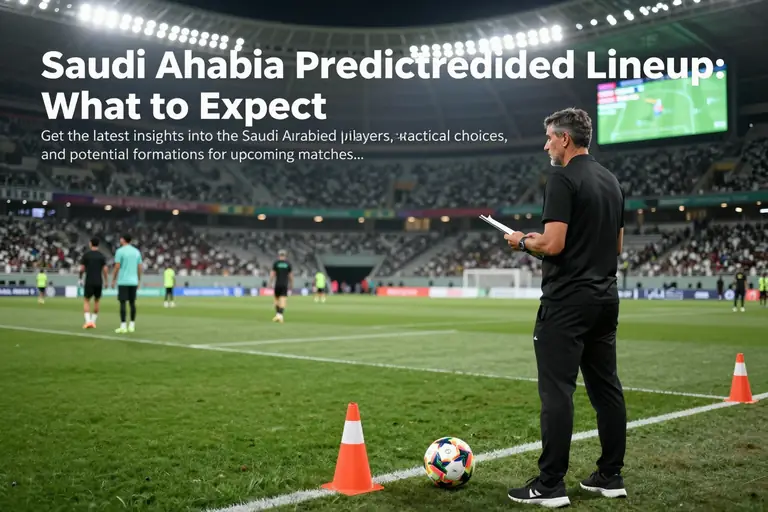
If you’re looking to understand the Saudi Arabia Predicted Lineup, you’ve come to the right place. We aim to provide a clear picture of how the national team might set up for their upcoming matches. This isn’t just about listing names; it’s about delving into the tactical preferences of the coaching staff, the current form of key players, and how these factors combine to form a probable starting eleven. Predicting a lineup involves considering various elements, from player fitness to opponent strengths, giving us a good estimate of what to expect on the pitch.
The Saudi Arabian national football team, often referred to as the Green Falcons, has a rich history in Asian football and has made several appearances on the world stage. Their performance is closely watched by fans globally, and the composition of their starting XI is always a hot topic of discussion. Understanding the nuances behind lineup predictions can enhance your appreciation of the game and provide insights into the team’s strategic approach.
Key Factors Influencing the Saudi Arabia Predicted Lineup
Predicting a football lineup is an art and a science. Several crucial factors consistently influence the coach’s decisions. Understanding these can help you better anticipate the Saudi Arabia Predicted Lineup for any given fixture.
Coach’s Tactical Preferences
Every coach has a philosophy. For Saudi Arabia, the technical staff often favors a specific formation or style of play. Are they known for defensive solidity, relying on quick counter-attacks, or do they prefer to dominate possession and build from the back? Historically, the Green Falcons have shown adaptability, but there are often underlying patterns. For instance, a coach might consistently use a 4-3-3 formation, meaning you’d expect three forwards, three midfielders, and four defenders, with variations in personnel. The current coach’s past teams and their preferred systems offer significant clues.
Player Form and Fitness
This is perhaps the most immediate factor. A player in stellar form for their club team is much more likely to start than someone struggling or just returning from injury. Fitness is non-negotiable; even the most talented player won’t feature if they’re not match-fit. Recent performances in domestic leagues or previous international games are heavily weighed. For example, if a striker has been consistently scoring, they’ll likely lead the attack. Medical reports and training ground observations are critical here, though often not publicly available until close to match day.
Opponent Analysis
No team plays in a vacuum. The opponent’s strengths and weaknesses play a significant role in determining the lineup. If Saudi Arabia is facing a team with strong wingers, the coach might opt for full-backs who are defensively solid. Against a team known for their physical midfield, a more robust central midfield pairing might be chosen. This tactical tailoring is crucial for gaining an edge. Coaches spend hours analyzing their adversaries to devise the most effective game plan, which directly impacts player selection.
Injury and Suspension Status
Unfortunately, injuries and suspensions are part of the game. A key player being unavailable due to a red card or a hamstring strain immediately opens up a spot in the starting eleven. This forces the coach to adapt and often provides opportunities for other players to step up. Keeping track of the latest injury reports is vital for an accurate prediction. These are often the most straightforward factors to confirm, as official statements are usually released regarding player availability.
Tournament or Match Importance
Is it a friendly match, a crucial World Cup qualifier, or a cup final? The stakes of the game can influence selection. In less critical matches, coaches might experiment with new players or formations, giving younger talents a chance or resting key players. For high-stakes games, they’ll almost always field their strongest possible team, relying on experienced and in-form players. The pressure of a major tournament can also lead to more conservative or pragmatic selections.
Common Formations and Key Positions for the Saudi Arabia Predicted Lineup
When discussing the Saudi Arabia Predicted Lineup, it’s helpful to consider the formations they commonly employ and the vital roles within those setups.
Typical Formations
The Saudi national team has historically used a few core formations, adapting them based on the coach and the opponent.
The 4-2-3-1 is a very common and balanced formation, offering solidity in defense and multiple attacking options. It features two holding midfielders, an attacking midfielder, and three forwards. This formation allows for quick transitions and flexibility. Another frequently used setup is the 4-3-3, an attacking formation that relies on strong wingers and a central striker. It provides width and often high pressing, aiming to overwhelm opponents with offensive firepower. Lastly, the 4-4-2, a classic, robust formation that provides two lines of four, making it difficult for opponents to break down. It can be flat or feature a diamond midfield, offering both defensive stability and options for direct attacking play.
The choice of formation will significantly impact which players are selected for specific roles, as each system requires different skill sets from its players.
Crucial Roles to Watch
Certain positions are almost always central to a team’s performance, regardless of the formation.
The Goalkeeper is the last line of defense. A reliable shot-stopper and good distributor are essential for building attacks from the back and commanding the penalty area. Central Defenders are the pillars of the defense, needing to be strong in the air, good tacklers, and capable of playing out from the back under pressure. Their partnership is crucial for defensive solidity. Central Midfielders often dictate the tempo of the game, breaking up opposition attacks and initiating their own. A strong central midfield can win or lose a match, as they control possession and link defense to attack. Finally, Strikers/Wingers are the primary goal scorers and creators. Their ability to finish chances, provide assists, and create opportunities through dribbling or movement is paramount for offensive success.
Projected Starting XI for an Upcoming Match (Example of Saudi Arabia Predicted Lineup)
While we cannot provide an exact, real-time Saudi Arabia Predicted Lineup without knowing the specific match details, we can illustrate a typical setup based on current trends and common player selections. This is a hypothetical example to show you how a lineup might be structured, assuming a standard 4-2-3-1 formation often favored by the team.
Goalkeeper: Mohammed Al-Owais (Known for his experience and reliable saves, a consistent presence between the sticks).
Defenders: At Right-Back, Saud Abdulhamid (Energetic, good going forward, and solid defensively). The Centre-Back pairing could feature Hassan Tambakti (Strong, commanding presence, good in aerial duels) alongside Ali Al-Bulaihi (Experienced, good aerial ability, and a vocal leader). At Left-Back, Yasser Al-Shahrani (Consistent performer, good defensively and in attack, provides width).
Midfielders: In the defensive midfield roles, Abdulelah Al-Malki (A tenacious ball-winner who protects the defense) and Mohamed Kanno (A box-to-box midfielder with good passing range and an eye for goal). The Attacking Midfielder position is often occupied by Salem Al-Dawsari (The creative spark, a significant goal threat, and often the captain, dictating play in the final third).
Forwards: On the Right-Wing, Firas Al-Buraikan (Known for his pace, directness, and ability to cut inside). On the Left-Wing, Abdulrahman Ghareeb (Showcases excellent dribbling ability and flair, capable of creating chances from wide areas). Leading the line as the Striker, Saleh Al-Shehri (A classic target man, good finisher, and holds up the ball well for teammates).
Potential Substitutes and Tactical Changes
The bench is just as important as the starting XI, offering the coach flexibility and game-changing options. Players like Sami Al-Najei (an attacking midfielder with an eye for a pass), Abdullah Madu (a versatile defender who can play across the backline), and Haitham Asiri (a pacy forward who can stretch defenses) are often called upon to change the game’s dynamic. Coaches might introduce a more defensive midfielder if they are protecting a lead, or bring on an extra attacker if they need a goal. The Saudi Arabia Predicted Lineup often includes a strong bench that can significantly influence the outcome, adapting to opponent strategies and in-game situations.
How to Stay Updated on the Latest Saudi Arabia Predicted Lineup News
To get the most accurate and up-to-date Saudi Arabia Predicted Lineup, it’s best to follow reliable sports news outlets and official team announcements. Relying on credible sources ensures you receive the most informed predictions and official confirmations.
Official Team Channels: The Saudi Arabian Football Federation (SAFF) often releases squad lists and sometimes even starting lineups closer to match day through their official website and social media accounts. These are always the most authoritative sources. Reputable Sports News Sites: Major sports news organizations with dedicated coverage of Middle Eastern football, such as ESPN, beIN Sports, or regional sports publications, are excellent sources for expert analysis and predicted lineups. Social Media: Follow trusted sports journalists and football analysts who cover the Saudi national team. They often share insights and potential lineups based on their sources, which can be very timely and informative.
Remember, these are predictions. The final lineup is only confirmed an hour or so before kick-off. Always check official sources for the definitive team sheet. If you’re considering placing a wager on a match, always play responsibly and be aware that last-minute changes due to injury, illness, or tactical adjustments can occur.
FAQ
What factors determine the Saudi Arabia Predicted Lineup?
The predicted lineup is shaped by the coach’s tactical choices, player form and fitness, the opponent’s style of play, any injuries or suspensions, and the overall importance of the match.
How reliable are predicted lineups?
Predicted lineups are educated guesses based on available information. While often close, they are not official and can differ from the actual starting XI, which is only confirmed shortly before kick-off.
Which formation does Saudi Arabia typically use?
Saudi Arabia often uses formations like 4-2-3-1, 4-3-3, or 4-4-2, depending on the coach and the specific tactical approach for a given match.
Where can I find the official Saudi Arabia lineup?
The official lineup is usually released by the Saudi Arabian Football Federation (SAFF) or major sports broadcasters about an hour before the match starts.